
![]() |
The "Triode Spirit family" |
HIGH END |

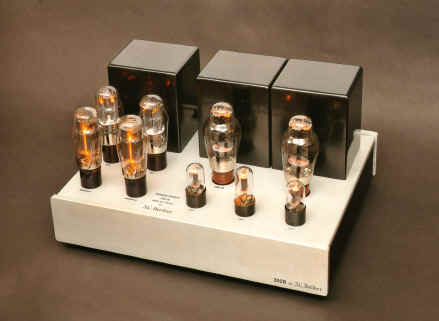
TRIODE SPIRIT 300B LUXE - NEW POWER SUPPLY |
|
The famous 300B was always honoured as much as possible on the
range of J.C.Verdier's amplifiers.
It is really a difficult exercise to obtain the best possible musicality with a
triode amplifier, because all must be perfect around the tube.
Now we introduce a new improvement in the circuits of the
regulated power supply.
It concerns a mounting with 3 additive tubes which tracks all remaining hum, for
that reason we call it "hum hunting circuit". And more this circuit
reduced the internal impedance to quasi nothing.
This improvement adds to the large number of those existent, it
leads the Triode Spirit Amplifier 300B Luxe to a degree of musicality never yet
reached.
The amplifier Triode Spirit 300B Luxe is fitted with 14 tubes
used in the following function :
2 X VV300B direct heating power triode
2 X 5U4 direct heating power rectifier
2 X 6AS7 twin power triode balast regulator
4 X 6EJ7 sharp cut-off pentode, µ follower input stage
3 X 6EJ7 sharp cut-off pentode
error amplifier - "hum hunting circuit"
1 X OB2 glow discharge reference voltage
Triode Spirit Amplifiers are now available in "Control" version.
They are integrated amplifiers allowing the input of 4 stereophonic sources at
the line level.
That convenience will certainly make the joy of music lovers that doesn't intend
to purchase a separate preamplifier.
Of course, that new possibility doesn't affect the legendary musicality of the
Triode Spirits that is still at the best level of the excellence : Respect of
harmonic richness of the Triode tube, total absence of hum and noise thanks to
its regulated power supply.
![]()
TRIODE
SPIRIT
THE GREAT FAMILY OF SINGLE ENDED AMPLIFIERS
2A3 - 300B - 845
The attraction carried on by the great audio triodes with direct heating of the filament is growing more and more.
Now, it is not possible to be ignorant of their qualities without being out of the High Fidelity world. Actually , 3 types are readily available covering virtually all requirements. They are the 2A3 , the 300B and the 845.
Understand that they were created long time ago
for the first talking movies , we must respect them in order to
arrive at the musical perfection they are able to provide.
Those triodes being tyrannical with the technicians who are faced
in designing an amplifier. There should be no compromise . The
design around the tube must be perfect or some default will
emerge and deteriorate the listening result, mainly by hum, and
/or a deficiency of the bass and treble .
If the cost needs to be lowered it is easier to use the
symmetrical mounting ( Push Pull ) which does not require the
same care.
Now, let us take a close look at the obstacle we must clear to obtain perfection ( yes it is possible ).
First of all the hum
Generally they come from the power supply circuits. Each model of the TRIODE SPIRIT line has a regulated power supply
It provides a constant voltage in all circumstances on all the amplifier stages. The regulated power supply, expensive to realize for the 2A3 and 300B models becomes a real technical challenge for the 845, as it needs a plate voltage of 820 Volts.
This power supply is in addition intricate to design ( see the article in Sound Practices issue 14 ) and it needs the use of 3 tubes ( in the 2A3 - 300B amplifiers) or 4 tubes ( in the 845 amplifier ) to work properly.
Response in low frequencies
A detractor of Mono Triode amplifiers will say : " Yes it's musical but there is no bass. This comment might be true if the amplifier is made to save money with a cheaply built output transformer .
The size and consequently the weight of the transformer is decisive because it conditions the value of the primary inductance which must be as high as possible. ( See the technical note on this subject ) The output transformer as a vital part must according be designed at its best , taking in account the finest technology, while respecting the rules of art.
Another challenge, the treble response.
Generally, the major problem comes from the dynamic input capacitance ( about 50 to 100pF ) of the power triode. This requires a preamplifier stage with low output impedance - practically a power stage - able to provide current in high frequencies . In a sort forcing the output triode to accept the modulation against its will .
To obtain this, we designed a completely innovative input stage, it consists of 2 tubes put in a configuration of " ultra linear mu follower pentode " ( please accept our apologies, but we could not find another name ). This stage presents the double benefit to have a very low output impedance ( about 100 Ohms ) and a negligible distortion.
This feature is valuable because it passes on an
ultimate profit: it does not change the original sound of the
output triode by an
inopportune compensation effect. This feature does not alter the
special sound of each triode and allows - possibly for the first
time - to make auditory comparisons really significant between
tubes of different origin.
For this last reason, we named this line of amplifiers "TRIODE SPIRIT" hopping to show the devoted care, the quasi religious character of our reverence for the great triodes of the past.
![]()
TECHNICAL
NOTE
THE CURIOUS DEVELOPMENT OF SINGLE ENDED POWER STAGE
At the origins of low frequency tube amplifiers,
the mounting of a single tube was reserved to devices using
simple and cheap materials .
By opposition the symmetrical mounting was meaning of perfection
and therefore found only on performing and expensive equipment.
It is interesting to note that this tendency is now quite
opposite. This surprising result has various reasons , two of
them are described below.
1 -
Poetical reasons
During the 70's Japanese enthusiasts -
passionate of music and technique - have discovered the qualities
of an old "WESTERN ELECTRIC" apparatus. This talking
picture amplifier designed for small movie theaters was fitted in
its output stage with a single tube 300B (WE 91A).
The amplifier was not perfect but gave surprising musical
results. The dynamics coming from this amplifier seems more
potent than its modest rated power let suppose. Working on the
matter by improving the power supply to reduce the " hum
"and using a bigger output transformer, our Japanese
enthusiasts gave birth to a new range of High Fidelity single
tube amplifier. We have to recognize that this amazing result was
,it seems,a real snook to the technical world.
2 -
Technical reasons
As we know, technical explanations given
their value to the musical results have never been approached .
For this reason, I ask the reader to take my conclusions only as
assumptions.
First, we have to evoke a specific aspect: The dynamics . Let us
suppose that a musical ( sinusodal) signal modulates the
grid of a tube in a positive direction: the plate current will
increase and become maximum. This current flowing in the primary
of an output transformer creates a maximum instant voltage at the
secondary corresponding to a maximum instant power.
When the signal modulates the grid of a tube in a negative
direction: the plate current will decrease and arrive to break
when the grid is at the cut-off point, the current inside the
primary of the output transformer ,then ,becomes zero. At the
secondary we recover a maximum instantaneous power, there is
no more current.
Where is this power coming from?
Of course there is the Lenz law which " works " by providing a magnetic field opposed to the disappearance of the current. This natural effect works well as much as the primary inductance of the output transformer is enough to store the energy; and there is the fundamental importance of the design of a generously sized output transformer if we wish to have a good reproduction of the low frequencies.
The energy stored in the primary is:
![]()
For example in a 300B stage, the idle current is
generally 75mA when a good transformer has a 20 Henrys primary
inductance.
In this case :
![]()
![]()
Let us calculate the distribution of this power
according to the frequency we have to reproduce:
At 20Hz the time necessary for the inductance to give back energy
is 0,025 seconds.
During this time the inductance is able to give back a power of :
![]()
It is not much and explains the fall of the power
in the bass extremities.
At 100Hz the time of return is 0,005 seconds. The corresponding
available power is:
![]()
This power is widely appropriate and the respone
at 100Hz is practically perfect .
The same calculation for the frequency 1000Hz reveals now why
Mono Triodes amplifiers have a musical power reserve so amazing.
At 1000Hz the time of restitution is 0,005 seconds that gives a
disposable power of:
![]()
Here we ought to compare with what happens in a push pull amplifier, it is easy because of their principle . The electricity stocked in the primary of the output transformer is always non-existent, and therefore the profitable phenomenon described above is not present.
In the future, I will comment about the reserves written at the beginning of this technical note. My assumptions are not yet confirmed by well-know scientific studies and I am waiting for the confirmation of a mathematician .
![]()
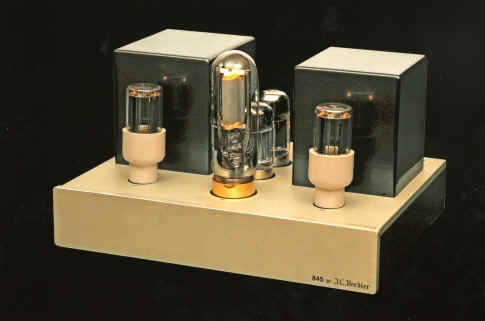
Last year, I added to my "Triode Spirit" amplifiers range a "luxe" version of the 845 model. The great success of that presentation, more attractive, in spite of its high price, leaded me to apply the same formula to my other amplifiers of the "'Triode Spirit" range :
It is now possible to obtain these models in "luxe" version and a middle version with bright stainless steel chassis is also available for 300B and 2A3 amplifiers.
Please notice that the 2A3 "luxe" model is equiped the same way as the 300B, with the same important transformers.
Moreover, all the technical aspects of the models are still the same and musical performances have not been modified by these aesthetic improvements.
| Jean Constant Verdier |

![]()
When the amplifiers of the "Triode Spirit" series were proposed for sale there was only one finish quality called "STandard" and consisted of a chassis covered by a a lacquered paint loaded with bronze powder.
Now the offer has evolved and the 2A3 and 300B "Triode
Family" amplifiers are available in 3 different finish aspects.
1) The "Standard Models" (described above)
2) The "Black shadow" Models : the chassis are made in mirror polished
stainless steel.
3) The "Luxe" Models are made on a brushed anodic and aluminium
chassis that is Champagne colored of 10 mm thick.
The 845 Model is proposed only in the "Luxe" version because we noticed that the standard version is quite as expensive as the "Luxe Version".
![]()
| TRIODE SPIRIT 845 | |
| Power Requirement | 230 V 50 Hz / 117 V 60 Hz or Request |
| Power Consumption | 300 Watts |
| Output Power | 20 Watts |
| Input Sensitivity | 400 mV |
| Total Harmonic Distortion | 0.5 % |
| Vacuum tube used | 1x845 - 2x5R4 - 2x6550 - 2xEL84 - 2xEF184.6EJ7 |
| Weight (Luxe) | 30 Kg |
| TRIODE SPIRIT 300B | |
| Power Requirement | 230 V 50 Hz / 117 V 60 Hz or Request |
| Power Consumption | 300 Watts |
| Output Power | 2x6 Watts |
| Input Sensitivity | 400 mV |
| Total Harmonic Distortion | 0.5 % |
| Vacuum tube used | 2x300B - 2x5U4 - 2x6080 - 5xEF184.6EJ7 |
| Weight | |
| Standard OR Black Shadow | 25 Kg |
| Luxe | 30 Kg |
| TRIODE SPIRIT 2A3 | |
| Power Requirement | 230 V 50 Hz / 117 V 60 Hz or Request |
| Power Consumption | 200 Watts |
| Output Power | 2x3 Watts |
| Input Sensitivity | 400 mV |
| Total Harmonic Distortion | 0.5 % |
| Vacuum tube used | 2x2A3 - 2xGZ34 - 2x6Y6 - 5xEF184.6EJ7 |
| Weight | |
| Standard OR Mirror | 15 Kg |
| Luxe | 30 Kg |
![]() |